

In the current market, finding effective executive tax reduction strategies in Canada is no longer optional; it is an architectural necessity. The market is currently running on a very specific, very fragile fuel source: hope.
Hope that the US Federal Reserve will cut rates perfectly; hope that the labour market will hold; hope that tech stocks won’t experience a massive correction. Hope is not a strategy. If you are asking \”why is my take home pay so low in Canada\” despite a high salary, hope is what happens when you do not have an engineered system.
If you are a high-achieving professional sitting in the top marginal tax rate in Ontario or across the provinces, you have won the income game. But when you apply standard, passive strategies to an executive-level profile, you create a perfect storm for capital destruction. This is an update on the defensive investment strategies you must adopt today.
PART 1: THE MACRO SIGNAL & CAPITAL PRESERVATION FOR EXECUTIVES
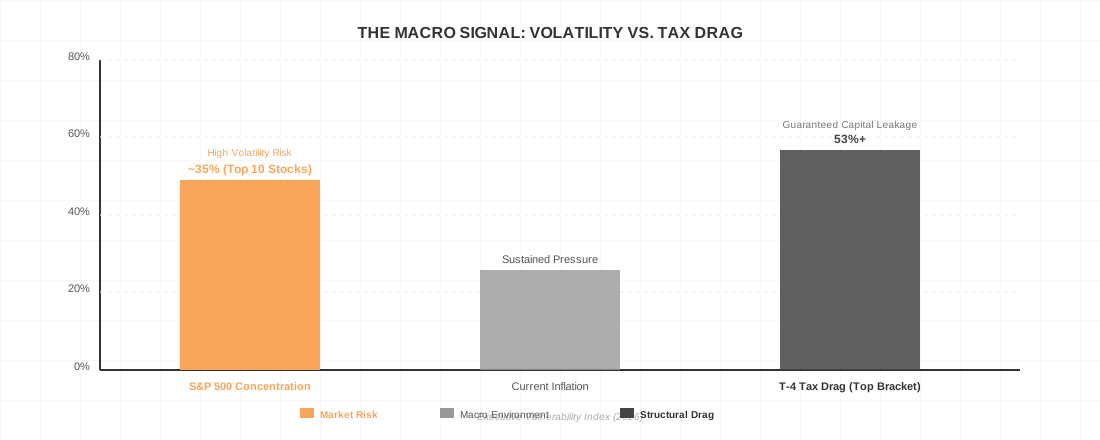
To understand the risk, we must look at the math of the current market structure. Concentration risk is at an all-time high, with the top 10 stocks in the S&P 500 accounting for roughly 35% of the index’s entire value.
For the high net worth Canadian, this volatility is catastrophic. You are facing a two-front war: market drawdowns on one side, and a guaranteed structural tax drag of 53% on the other. Every dollar of passive income you generate is effectively cut in half before inflation even touches it. True private wealth management for executives in Canada must prioritize protection over speculation.
PART 2: Implementing executive tax reduction strategies IN CANADA
[FEATURED SNIPPET LOGIC]: Many professionals search for tax strategies for high earners in Canada for 2026, only to find generic advice about RRSPs. While deferral is fine, true Canadian executive tax planning requires a shift from “buy-and-hold” to structural engineering. If your capital is exposed to full passive income taxation, you are trying to fill a bucket that has a massive, structural hole in the bottom.
PART 3: THE 3 RULES OF MONEY — A DEFENSIVE FRAMEWORK
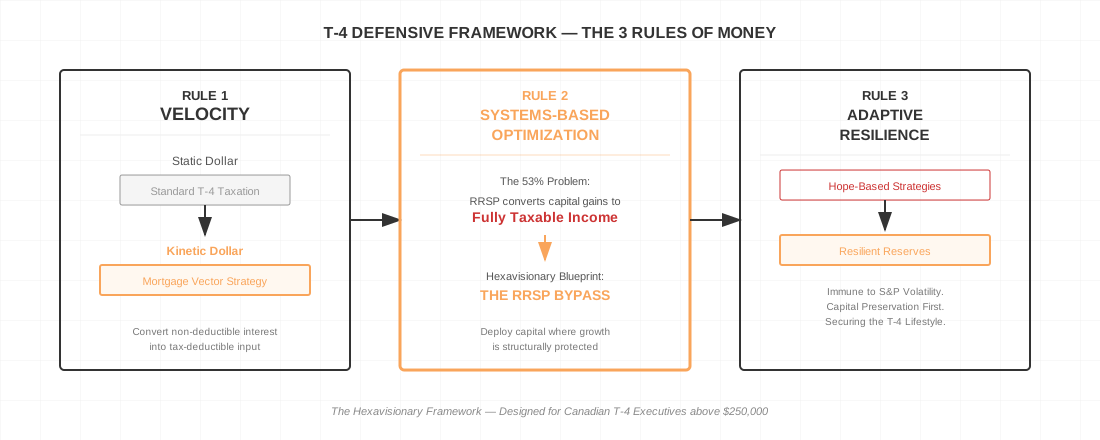
To thrive, you must transition to an active, defensive wealth management strategy using the Hexavisionary Framework:
Rule 1: Wealth Velocity
Keep every dollar in motion. Tax-efficient retirement planning for executives means deploying capital into structures where it generates tax-deductible inputs. It means converting “dead equity” into working capital.
Rule 2: Systems-Based Optimization
The highest earners utilize structures designed specifically for their marginal tax bracket. We seek to bypass the “RRSP Trap”—where capital gains are eventually converted into fully taxable income—and move toward structurally protected growth.
Rule 3: Adaptive Resilience
In 2026, the goal is capital preservation for executives. You need \”Resilient Reserves\” — capital deployed in ways that are immune to market swings, securing your lifestyle regardless of the S&P 500’s performance.
PART 4: MORTGAGE INTEREST TAX DEDUCTION IN CANADA (CRA RULE 20)
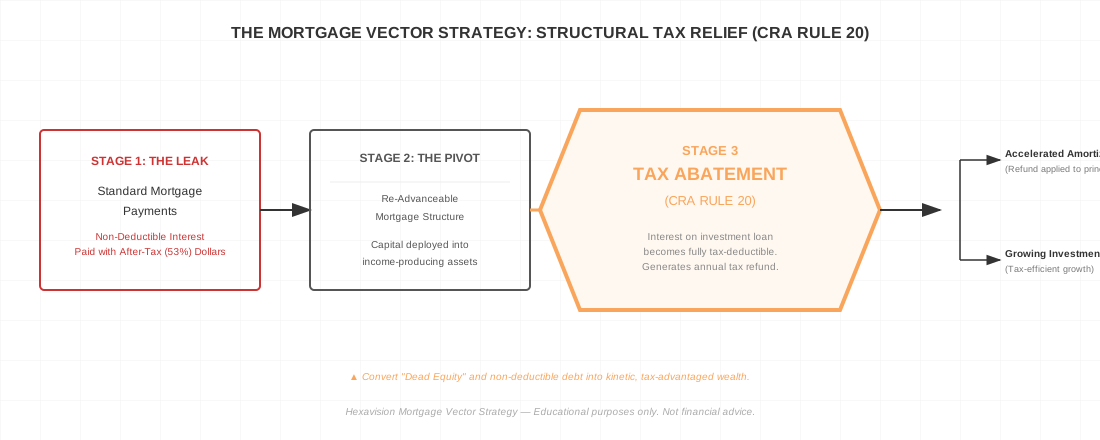
One of the most powerful executive compensation tax strategies is The Mortgage Vector. Most professionals pay their mortgage using after-tax dollars, meaning you must earn $2.12 to pay $1.00 of principal. This is a massive structural leak.
You may have heard the Smith Maneuver explained before, but The Mortgage Vector is a more clinical, engineered approach. Using CRA interest deductibility rules (Rule 20), we systematically convert non-deductible mortgage interest into a tax-deductible wealth engine.
This generates an annual tax refund, which you apply directly back to your principal. You accelerate your mortgage-free date and build a low-volatility portfolio simultaneously—all without changing your monthly cash flow. This is the ultimate tax-efficient debt restructuring.
THE IMPERATIVE: NAVIGATING THE 2026 TAX LANDSCAPE
With recent changes to the capital gains inclusion rate in Canada for 2026 and the impact of the Alternative Minimum Tax (AMT) on high earners, the cost of doing nothing has never been higher. Every month your capital sits in an inefficient position is a month of compounded leakage.
If you are ready to stop guessing and start engineering your executive retirement lifestyle, we have prepared an exclusive masterclass breaking down these engineered blueprints.
Borrowing to invest is a strategy that magnifies both gains and losses. Stop Guessing. Start Engineering.
— Kanwaljit (Sunny) Kochar
Senior Wealth Strategist | Hexavision