

 Executive Summary: The 2026 Spring Economic Update
The 50% capital gains inclusion rate remains unchanged, but this apparent victory may hide a larger long-term challenge for Canadian business owners. With a projected $66.9 billion deficit, future tax policy could place greater pressure on corporate retained earnings, making Corporate Tax Planning more important than ever.
A proactive approach to Corporate Tax Planning Canada can help business owners protect wealth, improve tax efficiency, and prepare for potential legislative changes. One notable opportunity is the government’s decision to make the $10 million Employee Ownership Trust (EOT) exemption permanent. This powerful tax planning strategy can support tax-efficient capital extraction while helping preserve business value and strengthen long-term financial security.
Rather than reacting to future tax changes, now is the time to implement a forward-looking Corporate Tax Planning strategy that safeguards your business and builds a resilient financial foundation for the future.
For the past two years, Canadian business owners, founders, and executives have been holding their breath.
The looming threat of a significantly higher capital gains inclusion rate—particularly the proposed increase to 66.67%—dominated boardrooms, corporate planning sessions, and conversations with tax professionals. It created growing uncertainty and reinforced the need for proactive Corporate Tax Planning to protect business wealth and long-term financial stability.
When the Honourable François-Philippe Champagne presented the 2026 Spring Economic Update (SEU), he confirmed there would be no increase to the capital gains inclusion rate and no changes to corporate tax rates. The inclusion rate remains at 50%, and the government also announced a modest reduction in the Canada Pension Plan (CPP) employer contribution rate.
While many business owners viewed this as welcome news, the celebration may be premature. The current tax environment has been preserved, but the underlying challenges remain. Without a strategic approach to Corporate Tax Planning Canada, businesses may continue to face unnecessary tax exposure and missed opportunities to improve tax efficiency.
Rather than relying on temporary policy stability, now is the ideal time to implement a forward-looking Corporate Tax Planning strategy that protects retained earnings, strengthens your corporate structure, and positions your business for sustainable long-term growth—regardless of future tax policy changes.
PART 1: THE ILLUSION OF THE CORPORATE VAULT
As a business owner, you likely view your HoldCo or operating company as a secure vault. You generate active income, pay the small business or general corporate rate, and park the retained earnings. You believe that as long as the capital gains rate doesn’t increase, your vault is secure.

This is the central fallacy of modern Canadian corporate structuring. The 2026 SEU did absolutely nothing to alter the punitive passive income rules introduced years ago. If you are investing your retained earnings in traditional portfolios, you are still subject to a corporate tax rate on passive income that often exceeds 50%.
“You deferred your tax realization, but you did not eliminate your tax liability. You are trading a single crushing blow for death by a thousand cuts.”
Between compounding payroll taxes, creeping carbon pricing, and the sheer inflationary erosion of your purchasing power, the status quo is just a slower bleed. Founders are exhausted not by a single tax, but by the relentless friction of the system.
PART 2: THE FISCAL TICKING TIME BOMB
To understand why “No New Taxes” is a temporary reprieve rather than a permanent victory, we must look at the macroeconomic data presented in the update. The government projected a deficit of $66.9 billion for the 2025-2026 fiscal year.

Deficits of this magnitude are not abstract numbers; they are deferred taxation. A government carrying massive structural debt has only two levers to pull: cut spending or raise revenues. Given the current political climate, significant spending cuts are highly improbable. Therefore, the revenue must increase.
Where will that revenue come from? It will not come from the median wage earner. It will come from the visible pools of accumulated wealth: corporate retained earnings, real estate portfolios, and business exits.
PART 3: THE GOLDEN TICKET (THE $10M EOT)
While the absence of new taxes captured the headlines, the most significant—and often overlooked—announcement was the government’s decision to make the $10 million Employee Ownership Trust (EOT) exemption permanent.
For Canadian business owners considering succession planning, this represents a valuable opportunity. If you’re among the many founders planning to exit your business within the next decade, this policy change could play a pivotal role in your Corporate Tax Planning strategy.
As part of an effective Corporate Tax Planning Canada approach, the Employee Ownership Trust (EOT) offers a tax-efficient way to transition business ownership while preserving long-term value. The EOT structure allows a business owner to sell company shares to a trust that holds the business on behalf of its employees, creating a smooth ownership transition while unlocking significant tax planning opportunities.
With the exemption now permanent, business owners have greater certainty to develop proactive succession and tax strategies. Instead of waiting until retirement or a future sale, incorporating an Employee Ownership Trust into your Corporate Tax Planning can help protect wealth, improve tax efficiency, and build a stronger legacy for both your business and its employees.
- The Math: Selling to an EOT is no longer just about legacy. It allows you to extract up to $10 million in capital gains entirely tax-free. For a founder facing a 50% inclusion rate and highest marginal personal tax brackets, this exemption represents millions of dollars in absolute, net-spendable wealth preserved.
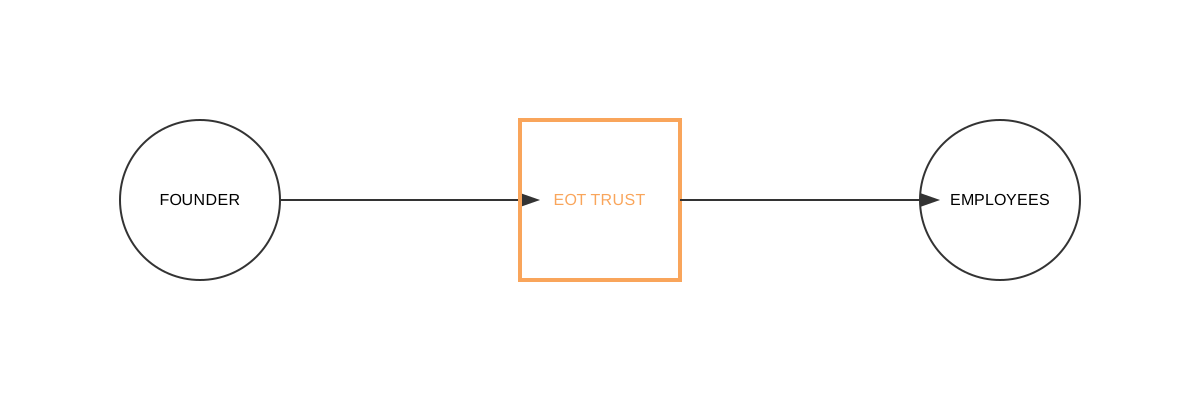
Yet, most accountants are treating the EOT as a niche structural anomaly rather than the cornerstone of a tax-exempt exit strategy.
PART 4: ENGINEERING THE CITADEL
The Employee Ownership Trust (EOT) exemption provides a powerful solution for business succession, but it doesn’t address another critical question: How do you protect the retained earnings already sitting inside your HoldCo? With Canada’s projected $66.9 billion deficit, future tax policy could place even greater pressure on corporate wealth, making proactive Corporate Tax Planning essential.
Rather than waiting for future tax changes, business owners should take a strategic approach to Corporate Tax Planning Canada by protecting corporate capital before new legislation is introduced. One effective strategy is to reposition retained earnings from highly taxed corporate assets into more tax-efficient structures.
A widely used solution is Corporate-Owned Life Insurance (COLI), which can help create a tax-advantaged environment for corporate wealth, support estate planning, and improve long-term capital preservation. When integrated into a comprehensive Corporate Tax Planning strategy, COLI can help business owners protect retained earnings while strengthening their overall financial plan.
For a complete tax-efficient strategy, explore our Insurance Protection services to learn how corporate insurance solutions can help safeguard business assets and support long-term wealth preservation. You can also discover our Estate Planning services to ensure your wealth is transferred efficiently and aligned with your long-term legacy goals.

| Strategic Objective | The Mechanism |
|---|---|
| Tax-Exempt Compounding | Reallocating surplus corporate cash flow into an over-funded life insurance policy allows the capital to grow completely free of the 50%+ passive income tax drag. |
| Liquidity Access | Through collateralized lending (Mortgage Vectors), you can access the cash value of the policy entirely tax-free for further investments or lifestyle funding. |
| The Capital Dividend Account (CDA) | Upon death, the death benefit flows through the CDA, allowing your heirs to extract the corporate wealth tax-free, entirely bypassing the double-taxation trap. |
When you combine a COLI structure to shield your current retained earnings with an EOT strategy for your eventual exit, you completely insulate your net worth from the whims of federal budgets.
THE IMPERATIVE OF ACTION
The 2026 Spring Economic Update provided Canadian business owners with one valuable advantage: time. It created a window of opportunity where the current tax rules are clear and the most significant proposed tax increases have been temporarily set aside. However, time alone is not a long-term solution.
Every day your retained earnings remain exposed to the standard corporate tax structure, your business may be missing opportunities to improve tax efficiency and preserve wealth. That’s why proactive Corporate Tax Planning is essential for protecting your capital and preparing for future legislative changes. A well-structured Corporate Tax Planning Canada strategy can help safeguard your business, optimize retained earnings, and strengthen long-term financial security.
Tax planning should also work hand in hand with your long-term financial goals. Integrating a comprehensive Retirement Planning strategy ensures that the wealth you build today supports your lifestyle and financial independence in the future. Learn more about our Retirement Planning services here: https://hexavision.ca/retirement-planning/.
Don’t wait for future tax policies to determine your financial outcome. Take control with a proactive Corporate Tax Planning strategy that protects your business, preserves your wealth, and helps you build a lasting financial legacy.
Saving. Start Building.
Secure your complementary “Dead Equity” Audit and determine if you qualify for the EOT Exemption.