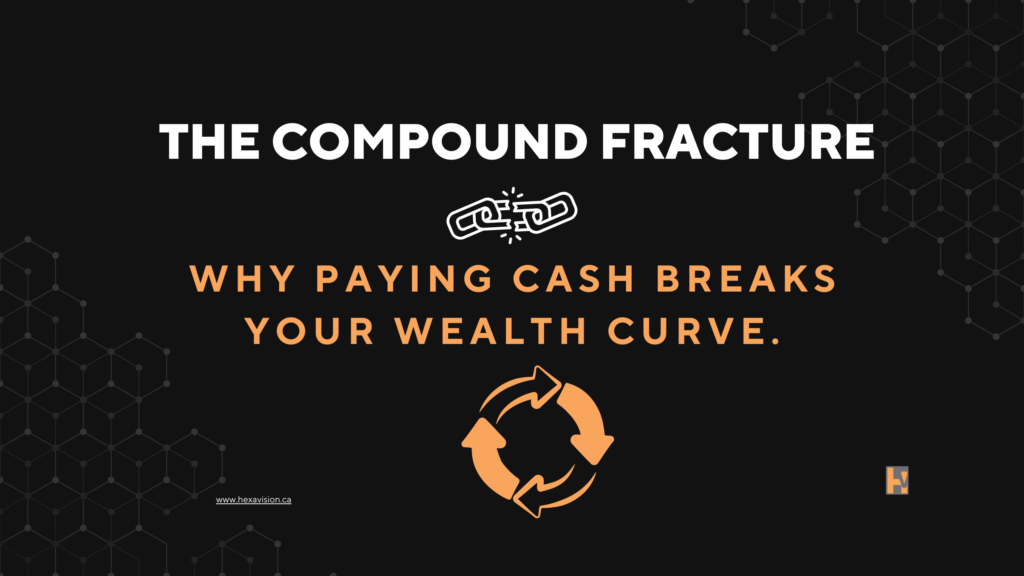

Stop aiming for "Debt-Free" and start aiming for "Inefficiency-Free." Here is the engineering case for keeping your money in motion.
If you are a Canadian business owner or C-Suite executive, you have likely been raised on a diet of well-intentioned but mathematically disastrous advice: “Pay off your debt. Own everything free and clear. Cash is King.”
In the high-stakes world of Wealth Engineering, cash isn’t king. Cash is a stopping point.
When you pay cash for a depreciating asset—like a luxury vehicle or a home renovation—or when you aggressively pay down a low-interest mortgage, you aren’t just spending money. You are creating what we call a “Compound Fracture.” You are permanently breaking the compound growth curve of that capital.
You didn’t just spend the $100,000. You spent what that $100,000 would have earned for you over the next 40 years. You killed the seed, so you will never eat the fruit.
This is the difference between the “Accumulator” mindset (save and spend) and the Wealth Engineer mindset (leverage and flow).
What is “Static Wealth” vs. “Kinetic Wealth”?
Most professionals suffer from Static Wealth. This is money that sits in “Dead Equity”—like the $1.5 million trapped in your paid-off home. It feels safe, but it is earning 0%. In an environment of inflation and taxation, 0% is actually a loss.
Kinetic Wealth is different. It is based on the physics of money. The goal is Velocity.
A Wealth Engineer never lets money leave their control. Instead of paying cash, they engineer a system where a single dollar does two jobs simultaneously:
It pays down inefficient “Bad Debt” (Non-Deductible).
It immediately readvances to build “Good Debt” (Tax-Deductible Assets).
We call this The Kinetic Dollar.
The Parable of the Hotel (Understanding Velocity)
To understand why paying cash is a mistake, consider this story:
A traveler walks into a hotel and places a $100 bill on the counter as a deposit. He goes upstairs to inspect a room.
The hotelier grabs the $100 and runs to pay the butcher.
The butcher runs to pay the farmer.
The farmer runs to pay the hotelier for a conference room he rented.
The hotelier puts the $100 back on the counter.
The traveler comes downstairs, decides he doesn’t like the room, picks up his $100 bill, and leaves.
The Math: No new wealth was created. The same $100 bill is back in the traveler’s pocket. The Magic: $300 of debt was eliminated because the dollar moved.
This is Velocity Banking. Most Canadians let their money die after one use. We want your money to behave like that $100 bill—cycling through your economy to eliminate debt without ever actually leaving your balance sheet.
How to Engineer the “Wealth Reactor”
You cannot execute this strategy with a standard bank account. You need a specific tool—a Readvanceable Mortgage.
Here is how the “Machine” works for our clients:
Income Injection: Your paycheck flows directly into the mortgage account, instantly suppressing the daily interest calculation.
The Readvance: As the principal drops, your borrowing limit automatically increases.
Deployment: You pull that new liquidity out to invest in income-generating assets (Private Credit, Dividend Stocks, REITs).
The Tax Shift: The interest on your mortgage was non-deductible (bad). The interest on the investment line is tax-deductible (good).
Over time, you convert your entire mortgage from a liability that you pay with after-tax dollars into a tax-deductible tool that the CRA helps you service.
The Bottom Line
Stop letting your equity sit dead in your drywall. You don’t need to be debt-free to be wealthy; you need to be inefficiency-free.
If you are ready to stop killing your capital and start engineering velocity, we need to audit your borrowing power.
DOWNLOAD THE 2025 RETIREMENT INCOME GUIDE
DISCLAIMER: The information provided in this content is for educational purposes only and does not constitute financial, legal, or tax advice. Hexavision strategies involve the use of leverage, which carries specific risks. Always consult with a qualified professional before modifying your financial structure.