Table of Contents
The Ultimate TFSA Guide for Canadians (2025): Your Blueprint to Tax-Free Wealth

It’s one of the most powerful financial tools available to Canadians, yet it’s hidden behind a misleadingly simple name: the Tax-Free Savings Account. That single word—“savings”—has led many to misunderstand its true purpose. Too often, it’s treated as a simple piggy bank for cash, left to earn minimal interest while its incredible potential is overlooked. Leaving a lot of money on the table for hardworking Canadians, missing the opportunity to maximize the efficiency of their money at work to earn compounding tax-free returns.
But what if we told you that the tax free savings account is not just a savings account? What if it’s actually a powerful engine for wealth creation—a flexible, tax-free vehicle designed to help you achieve your most important financial goals, from buying a home to building a comfortable retirement?
At Hexavision, our mission is to provide Empowerment Through Knowledge , and that starts with demystifying the Canadian investment pillars and tools that can lead you to achieve total financial freedom way faster than conventional wisdom. This guide is your foundational blueprint to mastering the tax free savings account . We’ll move beyond the basics to show you how this account can become a cornerstone of your tax-efficient wealth creation strategy, helping you grow your money completely tax-free and secure your financial future. It’s time to rethink what a “savings account” can do.
The Tax-Free Savings Account ( tax free savings account ) is one of the most powerful tools Canadians have to grow wealth without paying tax on investment gains. If you want a detailed breakdown of this year’s numbers, check out our guide on the TFSA Contribution Limit 2025 for the latest rules and maximization strategies.
What is a TFSA? Unpacking the Foundation of Tax-Free Growth
Before you can use the tax free savings account to its full potential, it’s essential to understand its foundational principles. Let’s break down what it is, what it isn’t, and who can open one.
The “Tax-Free” Advantage Explained
The core concept of the tax free savings account is simple yet profound. Unlike a traditional investment account known as a Non-Registered Investment account (Tax as you go), where you pay capital gains tax on your profits, or an RRSP, where you pay tax on withdrawals (Tax me later on withdrawals), the tax free savings account offers a unique advantage. You contribute with after-tax dollars, and in exchange, every dollar of growth your investments generate is completely tax-free for life. This includes interest, dividends, and capital gains. When you decide to withdraw your money—for any reason at all—it comes out 100% tax-free. I call it the “Tax me never again” account.
Why It’s More Than a “Savings” Account
This is the most critical concept to grasp. The tax free savings account is not just a high-interest savings account; it’s a powerful investment vehicle. Think of it as a special investment pillar. The real power comes from what you choose to
put inside the investment account. While you can hold cash in a tax free savings account , its primary purpose is to serve as a tax shelter for investments with the potential for significant long-term growth. By holding only cash, you miss out on the opportunity to shield substantial tax on capital gains and dividends from taxation, effectively squandering the account’s most valuable feature.
Who is Eligible to Open a TFSA in Canada?
Eligibility for a tax free savings account is straightforward. To open an account and start contributing, you must meet two main criteria:
- You must be 18 years of age or older.
- You must have a valid Canadian Social Insurance Number (SIN).
Your tax free savings account contribution room starts accumulating from the year you turn 1811. Interestingly, in provinces where the age of majority is 19 (like British Columbia or Newfoundland), you still earn contribution room for your 18th year; you just have to wait until you turn 19 to open the account and make that “catch-up” contribution.
Understanding Your Tax Free Saving Account Contribution Room: The Key to Maximizing Your Account
Your contribution room is the total amount you are allowed to put into your tax free savings account . Understanding how it works is critical to using the account correctly and avoiding costly penalties.
The 2025 Annual Limit and Your Cumulative Total
The government sets a new tax free savings account dollar limit each year, which is indexed to inflation.
- For the year 2025, the annual tax free savings account contribution limit is $7,000.
- For anyone who has been eligible since the program began in 2009, the total cumulative contribution room as of January 1, 2025, is
$102,000.
Behind the Numbers: Why $7,000 Again for 2025
The 2025 contribution limit demonstrates how the TFSA indexing formula works in practice. The inflation-indexed amount for 2025 is actually $6,963 (based on the 2.7% indexation factor), but since tax free savings account limits are rounded to the nearest $500 increment, this becomes $7,000. This technical detail helps explain why limits don’t increase every year—the indexed amount must cross the next $500 threshold ($7,250 in this case) to trigger an increase.
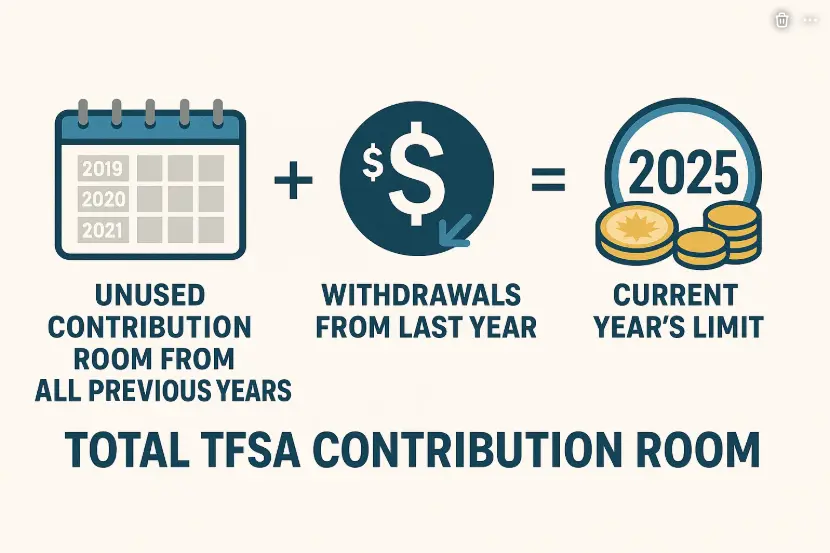
The Official Formula for Your Contribution Room
Your personal tax free savings account contribution room for the current year is calculated with a simple formula that adds together three distinct parts:
[Unused Contribution Room from All Previous Years] + [Total Amount of Withdrawals You Made Last Year] + [The Current Year’s Annual Limit]
Investment gains or losses inside your TFSA have no impact on this calculation. If your investments grow, that growth doesn’t reduce your contribution room. Conversely, if your investments lose value, that lost room cannot be regained.
The Golden Rule of Re-contributing Withdrawn Funds
This is the single most important rule to remember to avoid the most common tax free savings account mistake. When you withdraw funds from your TFSA, you are allowed to re-contribute that amount. However, the full amount of your withdrawal is only added back to your contribution room on January 1st of the following calendar year.
If you withdraw money and re-contribute it in the same year without having enough existing contribution room, you will face an over-contribution penalty.
How to Find Your Official Contribution Room (and Why You Should Track it Yourself)
You can find your tax free savings account contribution room information through the Canada Revenue Agency (CRA) by:
- Logging into your secure “My Account for Individuals” portal.
- Using the automated Tax Information Phone Service (TIPS).
- Requesting a tax free savings account Room Statement from the CRA.
Crucially, you should not rely solely on the CRA’s number. Financial institutions have until the end of February to report the previous year’s transactions. This means the figure in your CRA account is often outdated and won’t reflect any contributions or withdrawals you’ve made in the current year. The legal responsibility to track your room rests with you, the account holder.
TFSA vs. RRSP: Choosing the Right Path for Your Financial Journey
For many Canadians, the central question is where to put their hard-earned money: tax free savings account or RRSP? The best choice depends entirely on your personal financial situation, income, and goals.
The Core Difference: Paying Tax Now on capital invested and Never Again on all the compounded growth at withdrawal ( tax free savings account) vs. Paying Tax Later on both capital invested, along with the compounded growth on withdrawal (RRSP)
2025 Numbers for Direct Comparison
For 2025 planning purposes, here are the current limits:
- TFSA: $7,000 annual limit
- RRSP: $32,490 maximum annual limit (18% of earned income up to this amount)
This means high earners can potentially contribute over four times more to their RRSP than their tax free savings account in a single year, making the tax arbitrage decision even more critical for maximizing your wealth-building strategy.
The decision creates a form of “tax arbitrage”. Here’s the fundamental difference:
- TFSA: You contribute with after-tax dollars. You get no immediate tax break, but your investment growth and withdrawals are tax-free forever.
- RRSP: You contribute with pre-tax dollars, getting a tax deduction today that lowers your current income tax bill. Your investments grow tax-deferred, but all withdrawals are
fully taxed as income in the future as ordinary income on both capital invested and the compounded growth. - For a comprehensive and current comparison of Tax Free Saving Account vs. RRSP features and limits, visit this trusted resource from TD Canada Trust:
TFSA vs. RRSP: Choosing Between the Two | TD Canada Trust
The choice hinges on a simple comparison: is your marginal tax rate higher now than you expect it to be in retirement?
To help you quickly compare these accounts side-by-side, here is a clear chart outlining the key tax and contribution differences between the TFSA, RRSP, and a typical non-registered investment account.
| Feature / Aspect | TFSA | RRSP | Non-Registered Account |
|---|---|---|---|
| Contributions | Made with after-tax dollars (not tax deductible) | Made with pre-tax dollars (tax deductible) | Made with after-tax dollars (not tax deductible) |
| Annual Contribution Limit (2025) | $7,000 | Lesser of 18% of earned income or $32,490 | No limit |
| Investment Growth | Completely tax-free | Tax-deferred until withdrawal | Taxable annually on interest, dividends, and 50% of capital gains |
| Withdrawals | Tax-free at any time, for any reason | Taxed as ordinary income upon withdrawal | No tax deductions; capital gains taxed on sale |
| Effect on Government Benefits | Withdrawals do not affect benefits like OAS/GIS | Withdrawals can reduce income-tested benefits | N/A — taxed as income |
| Age Limits | None | Must convert or withdraw by age 71 | None |
| Contribution Room Carry Forward | Yes, unused room rolls forward indefinitely | Yes | N/A |
| Re-contribution of Withdrawals | Allowed next calendar year without penalty | Withdrawals reduce contribution room | N/A |
| Purpose | Flexible — any savings goal, emergency fund, retirement | Primarily retirement savings | General investing, limited tax efficiency |
Scenarios Where the TFSA is Your Clear Winner
A tax free savings account is often the superior choice if you are:
- In a lower income bracket now but expect to earn more later. It’s better to pay tax on your contributions now while your rate is low and save your valuable RRSP room for your peak earning years.
- Need flexibility and potential access to your funds. tax free savings account withdrawals are tax-free and the room is restored, making it ideal for major goals like a down payment or an emergency fund without penalty.
- Concerned about retirement benefits. tax free savings account withdrawals do not count as income and therefore will not reduce or “claw back” government benefits like Old Age Security (OAS) or the Guaranteed Income Supplement (GIS).
When an RRSP Might Be the More Powerful Choice
An RRSP generally provides a greater benefit if you are:
- In a high marginal tax bracket now and expect to be in a lower one in retirement. The upfront tax deduction is more valuable when your current tax rate is high, and you’ll pay tax on withdrawals later at a lower rate.
- Looking to access programs like the Home Buyers’ Plan (HBP) or Lifelong Learning Plan (LLP), which are unique features of the RRSP.
A Powerful Partnership: Using Both Accounts to Build Your Wealth Ecosystem
The most sophisticated financial plans don’t treat this as an “either/or” decision. The optimal strategy often involves using both accounts in a coordinated way. For example, a popular and powerful strategy is to contribute to your RRSP to get the tax deduction, and then immediately contribute the resulting tax refund into your tax free savings account . This allows you to capture the advantages of both accounts, building a robust and tax-efficient “Wealth Ecosystem.
Unlocking Your TFSA’s True Power: Smart Investment Strategies
To truly harness the tax free savings account potential, you need to shift your mindset from “saving” to “investing.” It’s a vehicle for long-term, tax-free growth as well as to transfer the wealth to the next generation tax free.
Beyond Cash: The Universe of Qualified Investments for Your TFSA
A TFSA can hold a wide range of qualified investments, generally the same types as an RRSP. This gives you the flexibility to build a diversified portfolio that matches your risk tolerance and goals. Common qualified investments include:
- Cash and GICs
- Stocks listed on a designated stock exchange
- Bonds (government and corporate)
- Mutual Funds and Exchange-Traded Funds (ETFs)
- Capital Protected Segregated Funds
The Magic of Compounding in a Tax-Free Environment
Compounding is the engine of wealth creation, and the TFSA is like a supercharger for that engine. When your returns are not eroded by annual taxes, your money grows on top of itself faster and more powerfully. Over decades, the difference between tax-free compounding in a tax free savings account and tax-dragged growth in a non-registered account can amount to tens or even hundreds of thousands of dollars.
A Quick Note on Foreign Investments
While you can hold foreign stocks in your tax free savings account , there’s a key detail to be aware of. Dividends paid by foreign companies are often subject to a non-resident withholding tax by that country’s government. For example, dividends from U.S. companies paid to a tax free savings account are subject to a 15% withholding tax by the IRS. This tax is not recoverable in a tax free savings account . This “tax drag” is an important factor to consider when deciding which assets to place in which accounts for maximum tax efficiency.
Avoiding Common Pitfalls: The Top TFSA Rules to Remember
The flexibility of the TFSA comes with a set of strict rules. Understanding them is key to avoiding significant financial penalties.
The 1% Over-Contribution Penalty Tax
If you contribute more than your available room, the excess amount is subject to a punitive penalty tax of
1% per month. This tax applies to the highest excess amount in your account for that month. Unlike an RRSP, there is no $2,000 buffer; the penalty applies from the very first dollar of over-contribution.
The Risk of “Day Trading” in Your TFSA
The CRA has rules against “carrying on a business” within a tax free savings account . While this is not explicitly defined, high-frequency “day trading” can trigger this rule. If the CRA determines your trading activity constitutes a business, any profits you make could be deemed fully taxable business income, nullifying the tax free savings account primary benefit. The tax free savings account is designed for long-term investing, not short-term speculation.
How to Seamlessly Transfer Your TFSA
If you want to move your tax free savings account from one financial institution to another, you must request a
qualifying direct transfer. This is a process handled directly between the two institutions. Do
not personally withdraw the funds and then deposit them into the new account. This sequence is treated as a regular withdrawal and a new contribution, which could easily trigger an over-contribution penalty if you don’t have enough room.
The TFSA in Your Estate Plan: A Powerful Tool for Generational Wealth
Properly setting up your tax free savings account is a critical and often overlooked part of estate planning. It can ensure your wealth is transferred smoothly and tax-efficiently.
Successor Holder vs. Beneficiary: The Critical Distinction for Your Spouse
This is the most important estate planning decision for your TFSA.
- A Successor Holder can only be your spouse or common-law partner. Upon your death, your spouse seamlessly becomes the new owner of your TFSA. The account’s tax-free status is preserved, the transfer does not affect their own tax free savings account contribution room, and the assets bypass your estate and probate fees. This is unequivocally the superior choice for a spouse.
- A Beneficiary can be anyone (a child, a friend, a charity). When you die, the value of the tax free savings account is paid out to them tax-free. However, the account itself is collapsed, and its future tax-sheltering power is lost. Any investment growth that occurs between the date of death and the payout date is taxable to the beneficiar.
Ensuring Your Wealth Passes On Efficiently and Tax-Free
By naming a successor holder or beneficiaries directly on your tax free savings account application, the funds are paid out directly to them, bypassing the lengthy and often costly probate process that your estate must go through. This makes the TFSA an incredibly efficient tool for intergenerational wealth transfer.
Conclusion: Your Journey to Total Financial Freedom Starts Here
The Tax-Free Savings Account is far more than its name implies. It is a dynamic, flexible, and powerful investment tool that is essential to any modern Canadian financial plan. By understanding its core principles—from the mechanics of contribution room to its strategic advantages over the RRSP and its role in your estate—you can transform it from a simple savings account into a formidable engine for tax-free wealth creation.
Remember, the key is to be proactive. Invest your contributions, meticulously track your room, and integrate your tax free savings account strategy with your other financial goals.
Achieving total financial freedom is a journey of empowerment, and it begins with mastering the tools at your disposal. At Hexavision, we are dedicated to providing the mentorship and innovative strategies you need to build that future.
To learn how you can maximize the efficiency of your money and start your journey towards a secure, self-funded retirement, connect with Hexavision today.
FREQUENTLY ASKED QUESTIONS:
Are TFSA contributions tax deductible?
No. Unlike RRSPs, contributions to a tax free savings account are made with after-tax dollars. You don’t get a deduction when contributing, but the benefit is that all future growth and withdrawals are tax-free.
Are TFSA withdrawals considered income?
No. Withdrawals are not considered taxable income, and they do not reduce government benefits like OAS or GIS.
Are TFSAs taxable at death?
The value of your TFSA on the date of death is tax-free. However, any growth after that date until the funds are paid out may be taxable to the beneficiary.
Are TFSAs subject to probate in Ontario?
If you name a successor holder or direct beneficiary, your TFSA bypasses probate. Without this designation, the account may pass through your estate and be subject to probate.
Can a TFSA lose money?
Yes. Since you can invest in stocks, ETFs, or mutual funds, your tax free savings account can decrease in value if the investments inside lose money.
Can TFSA contributions be carried forward?
Yes. Any unused contribution room rolls forward indefinitely, so you never lose it.
Can a TFSA be withdrawn anytime?
Yes. You can withdraw funds whenever you like, for any purpose, without paying tax.
Can a TFSA be claimed on income tax?
No. tax free savings account contributions do not reduce taxable income and are not reported as a deduction on your tax return.
How TFSA withdrawals work
Withdrawals are tax-free. The amount you withdraw is added back to your contribution room the following January 1.
TFSA how much can I contribute?
In 2025, the annual limit is $7,000. If you’ve been eligible since 2009 and never contributed, your total lifetime room is $102,000 as of January 1, 2025.
TFSA how to open
You can open a TFSA at most banks, credit unions, or online brokerages if you are 18 or older and have a valid SIN.
Where to find TFSA contribution room?
You can check your CRA “My Account,” call CRA’s automated TIPS service, or request a tax free savings account Room Statement. Always track your own contributions too, since CRA records may be outdated.
TFSA how many trades allowed?
There is no set limit, but if you trade too frequently, the CRA may treat it as business activity, and your gains could be taxed.
TFSA what is considered day trading?
Day trading means frequent, speculative trades with the intent of making business-like profits. The CRA may tax these profits as income instead of allowing them to remain tax-free.
Can a TFSA be in USD?
Yes. Some brokerages let you hold U.S. dollars in your tax free savings account to avoid currency conversion fees.
Can a TFSA hold USD?
Yes. You can hold U.S. investments like stocks or ETFs. However, dividends from U.S. companies face a 15% withholding tax that cannot be recovered in a tax free savings account .
Can a TFSA be inherited?
Yes. A spouse or common-law partner can inherit the TFSA directly and keep its tax-free status. Others can receive the funds, but the account itself will close.
Can a TFSA be transferred to spouse on death?
Yes. Naming your spouse as a successor holder allows them to take over the TFSA without affecting their own contribution room.
Can a TFSA have beneficiary?
Yes. You can name a spouse, child, or other individual as a beneficiary. They’ll receive the value of your TFSA tax-free up to the date of death.
TFSA when someone dies
At death, the TFSA can pass to a successor holder (spouse/partner) or be paid to beneficiaries. Growth after the date of death may be taxable.
Who gets my TFSA when I die?
If you name a successor holder, your spouse/partner takes it over tax-free. If you name beneficiaries, they receive the funds tax-free up to the date of death value. Without designations, it passes through your estate.
Why TFSA is better than RRSP?
For many Canadians, the TFSA is better because withdrawals don’t count as income, don’t reduce benefits, and are tax-free for life. It’s especially useful for those in lower income brackets now.
Why TFSA over savings account?
A TFSA can hold investments like stocks, ETFs, and bonds, shielding all growth from tax. A regular savings account only pays interest, which is fully taxable.
Which is better TFSA or FHSA?
If your goal is a first home, the FHSA provides special tax advantages. For general wealth building and flexibility, the TFSA is better. Many Canadians benefit by using both together.
When did TFSA start in Canada?
The TFSA program began on January 1, 2009, with an initial annual limit of $5,000.
Which government introduced TFSA?
The TFSA was introduced in the 2008 federal budget by the Conservative government under Prime Minister Stephen Harper.