Table of Contents
The Ultimate Guide to RRSPs: Your Master Key to a Richer Retirement

We all dream of retirement. For some, it’s a vision of sandy beaches and endless sun. For others, it’s the freedom to pursue a passion project, spend more time with family, or simply enjoy a life free from the 9-to-5 grind. But these dreams don’t just happen; they are built, contribution by contribution, decision by decision. In Canada, one of the most powerful tools you have to build that dream is the Registered Retirement Savings Plan (RRSP).
Think of an RRSP not just as a savings account, but as a time machine for your money. It allows you to take dollars from your high-income, high-tax working years and transport them to your lower-income, lower-tax retirement years, all while giving them a supercharged, tax-sheltered environment to grow.
This guide is your comprehensive hub for understanding the RRSP. We’ll demystify the jargon, break down the core mechanics, and show you how to transform this government-registered plan into a cornerstone of your financial freedom. Whether you’re a recent graduate starting your first job or a seasoned professional looking to optimize your savings, this is your starting point for mastering the RRSP.
What Exactly is a Registered Retirement Savings Plan (RRSP)?

At its core, the definition provided by the Canada Revenue Agency (CRA) is straightforward: an RRSP is a retirement savings plan that you establish, that we (the CRA) register, and to which you or your spouse or common-law partner contribute.
Let’s break that down.
- It’s a Personal Plan: You open and own your RRSP. It’s your personal nest egg.
- It’s Registered: This is the magic word. “Registered” means the plan is recognized by the Canadian government and, in exchange for following certain rules, you receive significant tax advantages. It turns a simple savings plan into a powerful wealth-building engine.
- It’s for Savings: Its primary purpose is to hold savings and investments to provide you with an income in retirement.
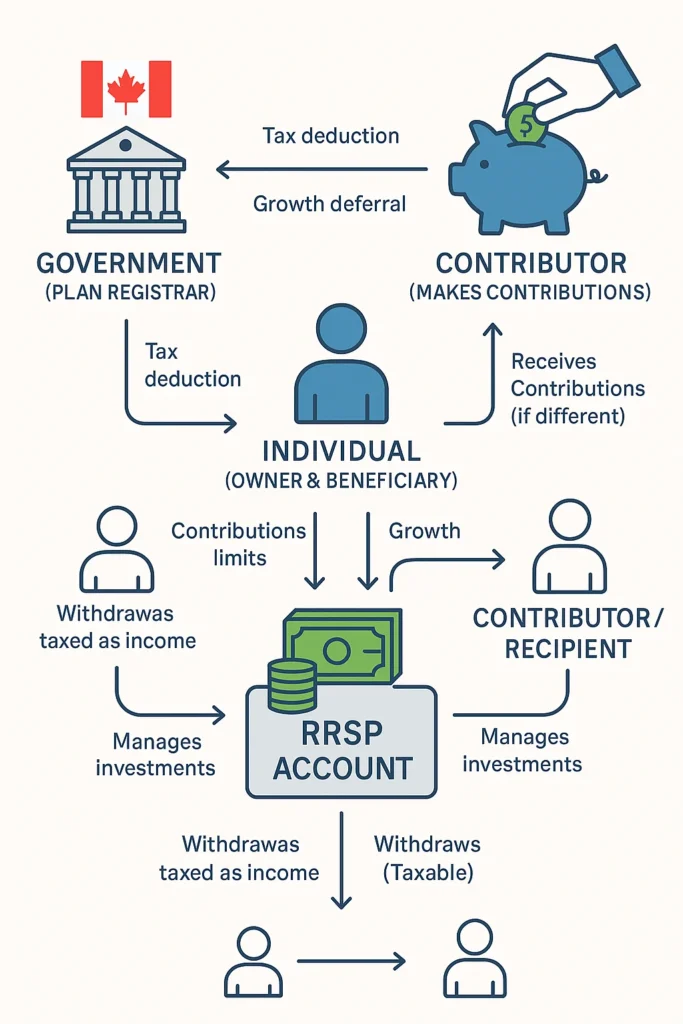
To understand how it works, it helps to know the three key players involved:
- The Annuitant: This is you—the owner of the account. The plan is registered in your name, and you are the one who will ultimately receive the income from it in retirement.
- The Contributor: This is the person (or people) who puts money into the plan. While this is usually the annuitant, a spouse or common-law partner can also contribute to a “Spousal RRSP” on your behalf. Crucially, the contributor is the one who gets to claim the tax deduction.
- The Issuer: This is the financial institution—like a bank, credit union, or investment firm—that provides and administers the plan. They handle the paperwork, manage the investments (if you choose), and report all the activity to you and the CRA.
Here’s a simple visual to show how these roles interact:
The “Why”: The Superpower of Tax-Deferred Growth
The single most important reason to use an RRSP is its power of tax deferral.
Imagine you have two planters. In Planter A (a regular, non-registered investment account), every time your plants grow (your investments earn returns), someone comes along and takes a cut of that new growth for taxes. Your plants still grow, but their progress is constantly trimmed back.
Now, imagine Planter B (your RRSP). Here, your plants are in a greenhouse. They grow and flourish, and no one takes a cut of the growth year after year. The leaves that grow from the stems get to grow their own leaves, leading to exponential, untrimmed growth. This is the power of tax-sheltered compounding. You only pay tax at the very end, when you take your fully-grown plants out of the greenhouse to enjoy.
This uninterrupted compounding allows your retirement savings to grow significantly faster and larger than they would in a taxable account, giving you a much bigger nest egg when you finally need it.
Just as your RRSP benefits from tax-sheltered growth, the biggest gains come when you combine it with smart retirement planning strategies in Canada that balance RRSPs, TFSAs, and other investment accounts.
How does RRSP Work: The Three Acts of an RRSP’s Life
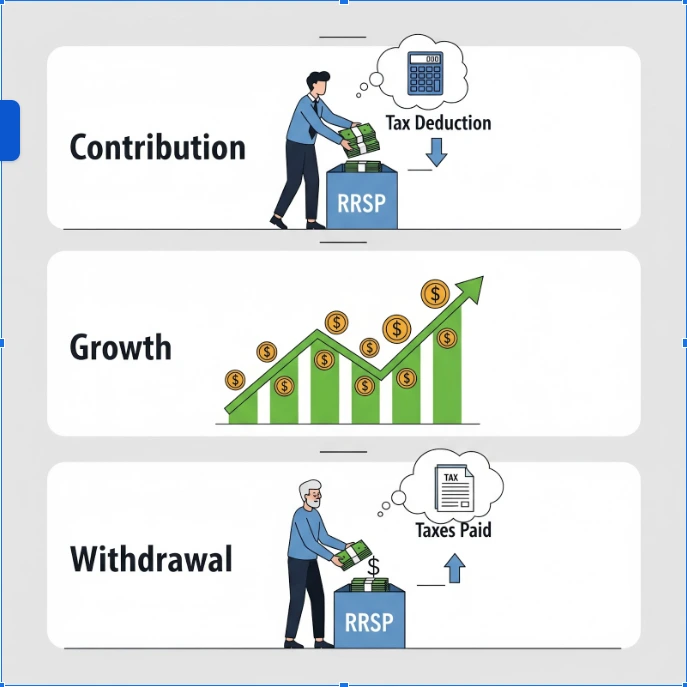
The magic of the RRSP unfolds over three distinct stages: Contribution, Growth, and Withdrawal. The core strategy is to take advantage of the difference in your tax rate between your contribution years and your withdrawal years.
Act 1: Contribution (The Tax Deduction)
When you contribute money to your RRSP, you get a tax deduction. This reduces your taxable income for the year, which can result in a significant tax refund.
How it works: If your marginal tax rate is 40% and you contribute $5,000 to your RRSP, you effectively erase $5,000 from the income the government can tax you on for that year. This could lead to a tax saving of $2,000 ($5,000 x 40%).
The benefit: This provides an immediate, tangible financial reward for saving. The higher your income (and thus your tax bracket), the more valuable this deduction becomes.
Act 2: Growth (The Tax Shelter)
Once your money is inside the RRSP, any investment gains—interest, dividends, or capital gains—are completely sheltered from tax.
How it works: The $5,000 you contributed can be invested in stocks, bonds, GICs, ETFs, and more. If those investments generate a 7% return ($350), you pay no tax on that gain. The next year, you earn returns on $5,350, and so on.
The benefit: This is the compounding superpower we talked about. Your money grows faster because the earnings that would normally go to the taxman stay in your account, working for you.
Act 3: Withdrawal (The Pay-Off)
Eventually, you will retire and start withdrawing money from your RRSP. It is only at this point that the money is taxed.
How it works: Any amount you withdraw is added to your income for that year and taxed at your marginal tax rate.
The strategy: For most people, their income in retirement is lower than during their peak earning years. You might go from a 40% tax bracket while working to a 20% tax bracket in retirement. You received a large tax break when you put the money in and pay a smaller amount of tax when you take it out.
This diagram illustrates the core concept: get a tax break at a high rate, let it grow tax-free, and pay tax later at a lower rate.
An RRSP works by allowing you to contribute tax-deductible amounts, which reduces your earned income for the previous tax year, ultimately deferring taxes until you make withdrawals. The funds in your RRSP can be invested in a wide range of investment options, including mutual funds, stocks, bonds, and exchange-traded funds (ETFs), and these grow tax-deferred over time. Contributions can be made until the year you turn 71, after which you must convert your RRSP into a RRIF (Registered Retirement Income Fund). When you withdraw from the RRSP, typically in retirement, the funds are taxed as ordinary income, but you can strategically plan your withdrawals to minimize your tax impact. Programs like the Home Buyers Plan (HBP) and Life Long Learners Plan (LLP) offer tax-free withdrawals under certain conditions, such as buying a home or funding education. Contributing to a spousal RRSP can provide tax benefits for both you and your common-law partner. In summary, how does RRSP work? It offers you the opportunity to save and grow your money with tax advantages, helping you achieve your retirement goals while managing your tax burden effectively.
5
The Rules of Contribution
The government sets limits on how much you can contribute to an RRSP.
Contribution Room: Your contribution limit is based on 18% of your “earned income” from the previous year, up to a maximum annual limit set by the government (for 2023, the maximum was $30,780; for 2024, it is $31,560).
Finding Your Limit: Your personal contribution limit can be found on your Notice of Assessment from the CRA after you file your taxes, or by logging into your CRA My Account online.
Unused Room Rolls Over: If you don’t use all your contribution room in one year, it carries forward indefinitely.
Contribution Deadline: You have until 60 days after the end of the calendar year to make contributions for the previous tax year. For example, to contribute for the 2024 tax year, you have until March 1, 2025.
Pension Adjustments (PA): If you are part of a company pension plan or deferred profit-sharing plan, your RRSP contribution room will be reduced. This is because your employer is already contributing to a registered retirement plan for you. The reduction is shown as a “Pension Adjustment” on your T4 slip.
What Can You Put in an RRSP?
An RRSP is like a basket. The basket itself is the registered account, but you get to choose what you put inside it. These are called “qualified investments.”
Common qualified investments include:
- Guaranteed Investment Certificates (GICs): Low-risk investments with a fixed interest rate.
- Mutual Funds/ Seg Funds: A diversified portfolio of stocks and bonds managed by a professional Fund Manager.
- Exchange-Traded Funds (ETFs): Similar to mutual funds but traded on a stock exchange.
- Stocks: Shares of ownership in individual companies.
- Bonds: Loans you make to a government or corporation in exchange for interest payments.
You can hold these investments in different types of RRSP accounts, from a hands-off, professionally managed plan to a self-directed account where you make all the trading decisions.
Early Access: The Home Buyers’ & Lifelong Learning Plans
While the RRSP is designed for retirement, the government allows you to borrow from it tax-free for two specific life events:
Home Buyers’ Plan (HBP): Allows eligible first-time home buyers to withdraw up to $35,000 from their RRSP to use as a down payment. You have to repay the amount to your RRSP over a 15-year period.
Lifelong Learning Plan (LLP): Allows you to withdraw up to $10,000 per year (to a maximum of $20,000) to finance full-time education or training for yourself or your spouse. This must also be repaid over a set period.
These programs are essentially interest-free loans from yourself, allowing your savings to serve a dual purpose.
The Final Act: Converting Your RRSP at Age 71
Your RRSP has a mandatory retirement date. You must wind up your RRSP by the end of the year you turn 71. You have three main options:
- Withdraw the Full Amount: You can cash out the entire RRSP. However, this entire amount would be added to your income in one year, resulting in a massive tax bill. This is rarely the best option.
- Purchase an Annuity: You give your savings to an insurance company, and they provide you with a guaranteed income for the rest of your life.
- Convert to a Registered Retirement Income Fund (RRIF): This is the most common option. A RRIF is like a mirror image of an RRSP. The investments can stay in place, continuing to grow tax-sheltered, but you are now required to withdraw a minimum percentage each year.
Is an RRSP Always the Answer? RRSP vs. TFSA
The RRSP has a famous cousin: the Tax-Free Savings Account (TFSA). While both are powerful savings tools, they work differently.
| Feature | RRSP | TFSA |
|---|---|---|
| Tax Deduction | Yes | No |
| Tax-Free Growth | Yes | Yes |
| Taxed on Withdrawal | Yes | No |
- When is an RRSP better? Generally, if you expect to be in a lower tax bracket in retirement than you are today, the RRSP offers a powerful advantage.
- When is a TFSA better? If you are in a low tax bracket now or expect to be in a higher one in retirement, the TFSA might be more beneficial. It also offers more flexibility, as you can withdraw money at any time without a tax penalty.
The ultimate strategy for many Canadians is not RRSP or TFSA, but RRSP and TFSA. Using both allows you to optimize your tax savings both today and in the future.
Is RRSP Worth It? Understanding the Benefits and Long-Term Financial Impact
An RRSP can be highly worth it for many individuals, especially when considering its tax-efficient nature and the potential for long-term money accumulation. Contributing to an RRSP provides a tax-deductible advantage, helping you lower your taxable income and potentially receive a refund. The savings grow tax-deferred, allowing your investments, such as mutual funds, ETFs, index funds, and bonds, to appreciate over time without being taxed yearly. For young people starting their careers, contributing early can significantly boost your retirement savings, as you can benefit from compounding growth and hedging against inflation and depreciating values.
Moreover, an RRSP can act as a hedge against financial uncertainty, as it offers protection from insolvency or bankruptcy, ensuring your funds are protected. By investing in a diversified portfolio of equity, bonds, and managed funds, you can achieve growth in global markets while mitigating risks like drawdown. Using a self-directed RRSP gives you the flexibility to choose alternative investments, including VEQT, XEQT, VGRO, and XGRO, which are popular ETF options for growth-focused portfolios.
Consulting a financial advisor is key to determining how to best allocate your RRSP contributions based on your financial goals and risk tolerance. Over the long term, RRSP contributions are likely to provide a substantial advantage, especially if you focus on low MER mutual funds or index funds with tax-efficient structures. Ultimately, the RRSP is an essential tool for tax-deferred growth, offering a secure financial outcome and a way to make the most of your taxable income during your working years.
What is RRSP deduction limit?
RRSP deduction limit refers to the maximum amount of money you can contribute to your RRSP and still claim a tax deduction on your income tax return. For the 2024 tax year, this limit is the lesser of 18% of your income from the previous year or the annual limit set by the CRA, which is up to $31,560.
Conclusion: Start Building Your Tomorrow, Today
The Registered Retirement Savings Plan is more than just an acronym on a government form; it’s a declaration of intent for your future. It’s a commitment to your dream of a comfortable, secure, and fulfilling retirement.
By understanding its core principles—the immediate tax deduction, the power of tax-sheltered growth, and the strategy of withdrawing at a lower tax rate—you unlock one of the most effective wealth-building tools available to Canadians.
To go beyond the basics, explore wealth planning strategies for Canadians that integrate RRSPs with other investment vehicles for maximum retirement security.
The journey to a successful retirement is a marathon, not a sprint. Every dollar you contribute is a step forward. The best time to start was yesterday. The second-best time is right now.
Ready to dive deeper? Stay tuned for our specialized “spoke” articles, where we will explore advanced topics like Spousal RRSPs, optimizing your RRSP investments, withdrawal strategies, and a detailed head-to-head comparison with the TFSA.