When Does EI & CPP Max Out? Find Out Before It’s Too Late!
In Canada, Employment Insurance (EI) and the Canadian Pension Plan (CPP) are vital programs that provide financial support to individuals. These programs have specific maximum contribution limits, which can impact your paycheck and net income (the first step to Total Financial Freedom) throughout the year. Knowing when these contributions max out can help you plan for changes in your payroll and increase the take-home income.
Every year, there are annual limits on how much you can contribute to both EI and CPP. For instance, in 2023, the maximum annual pensionable earnings for CPP was set at $66,600. This means if your income exceeds this amount, you no longer need to make contributions to CPP for the remainder of the year. Similarly, maximum annual insurable earnings for EI were capped at $61,500 in 2023. Once you reach these limits, EI premiums are no longer deducted from your paychecks.
The contribution rates for both programs are a key factor in how these limits affect your earnings. In 2023, the CPP contribution rate was 5.95%, and the EI rate was 1.63%. This means that for each dollar you earn, these rates determine how much is deducted for your contributions until you hit the maximum annual amount.
Once you surpass the maximum contribution limits, the deductions for EI and CPP stop. For employees, this can result in a higher paycheck for the remainder of the year, which translates to a higher net income. This change can feel like a pay raise, but it’s actually just the deductions coming to an end. However, if you’re self-employed, the employer portion of contributions still applies, meaning you will continue to contribute even after reaching the limits.
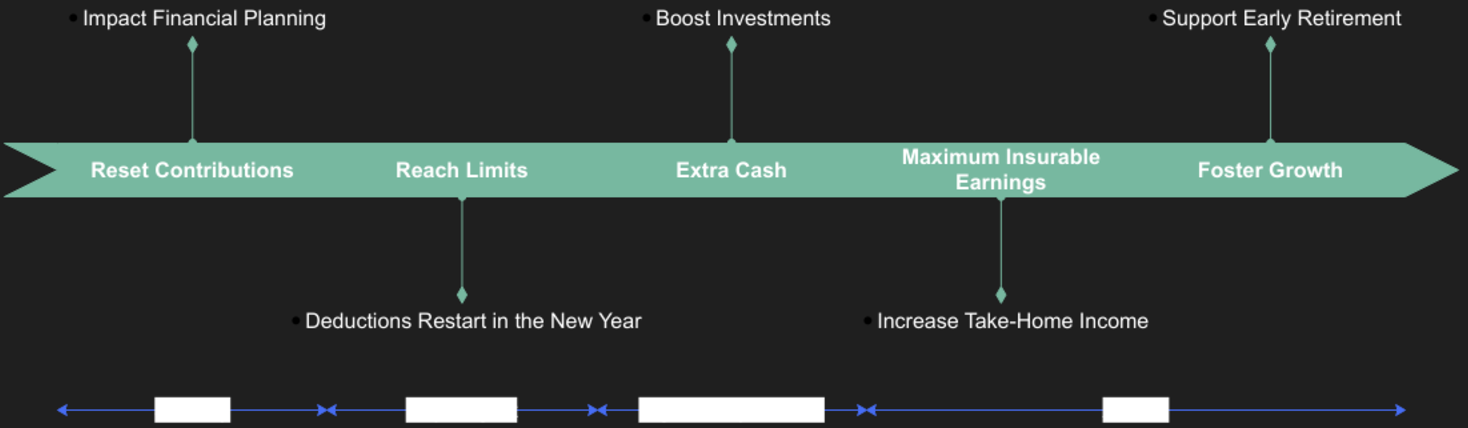
- Each year, EI and CPP contributions reset in January, impacting financial planning.
- Contribution limits are often reached by July or August, with deductions restarting in the new year.
- These resets act as a reminder to adjust your budget based on earnings and payroll deductions.
- For higher-income individuals, exceeding the contribution limits creates a significant change in net pay.
- After premiums stop being deducted, there is an increase in take-home income.
- Reaching the maximum annual insurable earnings allows extra cash for investments.
- This fosters growth, boosts future financial security, and supports an early, prosperous retirement.
- Recognizing the timing of these shifts can make a difference in months with high salary and fewer deductions.Maximizing your CPP and EI benefits is just one part of a larger financial picture. To ensure you’re making the right decisions for your future, check out Important Financial Decisions That Everyone Should Make.Custom HTML/CSS/JAVASCRIPT
When Does EI and CPP Max Out? Here’s What You Need to Know
When it comes to understanding how your contributions to Employment Insurance (EI) and the Canada Pension Plan (CPP) work, it’s essential to know when they max out. This knowledge can significantly help you manage your finances more effectively. For instance, once your contributions reach their maximum limit, you’ll notice a shift in your deductions, which can be an opportunity to see a better net income in the latter part of the year. This change not only aids in helping you plan for the future but also in ensuring you stay compliant with government rules.
As someone who has navigated this financial landscape for years, I’ve found that understanding these contribution limits early in the year allows for smoother financial planning. It provides a clearer picture of what your net income will look like once the deductions are no longer applicable. This way, you can strategically plan your expenses or savings for the future, making sure you’re making the most of the shift in your finances. Staying informed about these changes is crucial for effective financial management and ensuring compliance with all regulations.
Comparing 2024 and 2025 CPP and EI Contribution Increases
When looking at 2024 and 2025 for CPP and EI contributions, it’s clear that both will see increases in maximum pensionable earnings and insurable earnings. For 2024, the YMPE (Year’s Maximum Pensionable Earnings) will be set at $68,500, and the YAMPE (Year’s Additional Maximum Pensionable Earnings) will be $73,200, leading to a maximum contribution of around $4,056 for employees. On the other hand, 2025 will see a rise in the YMPE to $69,700 and YAMPE to $79,400, pushing the maximum contribution to approximately $4,327.
The EI contributions will also follow a similar trend. For 2024, the maximum insurable earnings is $63,200, and with the 1.66% rate, employees will see a maximum contribution of $1,049.12. However, 2025 will bring a slight reduction in the rate to 1.64%, but the maximum insurable earnings will increase to $65,700, resulting in a maximum contribution of $1,077.48. These changes mean that more people will be contributing higher amounts, but also that they’ll be able to benefit from higher payouts when they retire or if they find themselves relying on EI.
Interestingly, not everyone experiences the same timing when maxing out their contributions. Some very lucky individuals manage to reach the maximum in their first paycheck of the year, while others, depending on their salary and how it grows, might reach this point much later. As these contributions increase, it’s essential to keep an eye on how your salary adjusts to ensure you’re on track and don’t miss out on these increases. If you’re someone who regularly maxes out at the end of the year, planning and adjusting accordingly can help you stay ahead of the changes.
As you consider how to maximize your EI and CPP benefits, it’s important to recognize that retirement planning is an ongoing process. For a deeper understanding of the challenges Canadians face, take a moment to explore Financial Freedom and Retirement Planning.
Understanding CPP and EI Contributions
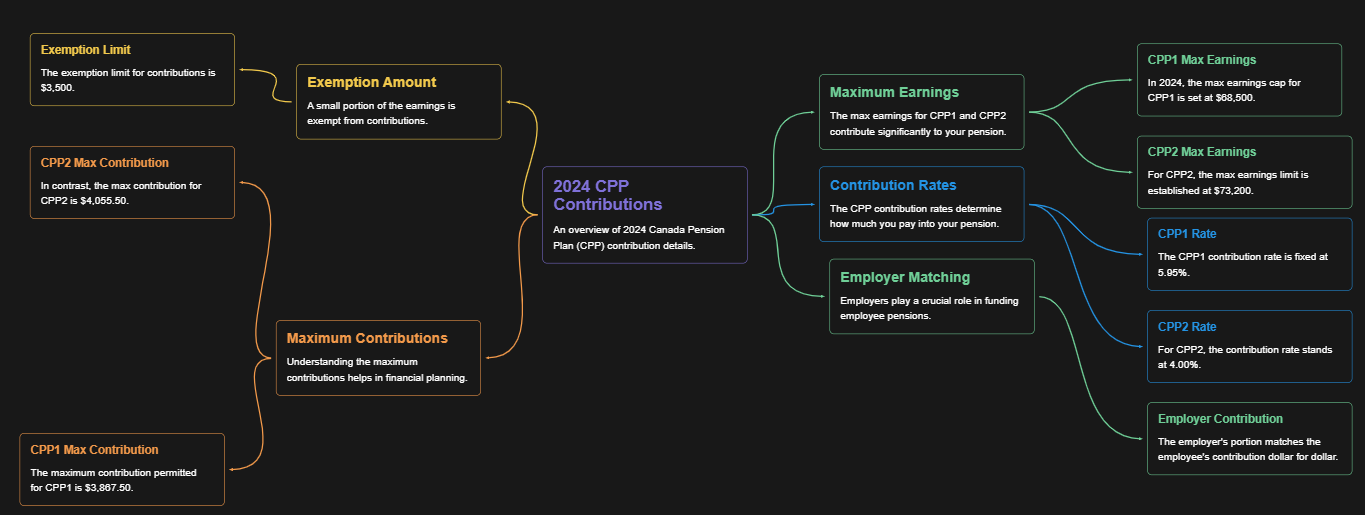
The Canadian Pension Plan (CPP) is one of the cornerstones of Canada’s retirement income system. It is designed to provide income to Canadians who are retired, unable to work due to disability, or the surviving spouse or partner of a deceased contributor. Workers contribute to the plan starting at age 18, and the amount they contribute is based on their earnings each year. In 2024, the maximum contribution for an employee is $3,867.50, which applies to earnings up to $68,500. For those who earn more, the second tier or YAMPE (Year’s Additional Maximum Pensionable Earnings) applies, which has a cap of $73,200. Contributions are made at a rate of 4% on income between the basic maximum and the second tier.
The CPP system also includes a special contribution rate called CPP2, which applies to earnings above the maximum YMPE and below the CPP2 maximum. This means if a worker has earnings above $81,200, they will pay 4% on the additional amount, but a portion of this, up to $9,900, is also deductible. In 2025, further adjustments will be made, including an increase to the maximum contribution and exemptions, which can vary slightly each year. This makes it crucial to understand how much you’re contributing to CPP as it directly affects the amount of benefits you’ll receive in the future.
In addition to CPP, Employment Insurance (EI) is another key program that provides temporary financial assistance to individuals who lose their job or are unable to work due to sickness, maternity, or parental leave. EI premiums are based on a percentage of an individual’s earnings, with a cap on the maximum insurable earnings. For 2024, the maximum EI contribution is based on $63,200 of earnings at a rate of 1.66%, meaning the maximum contribution is $1,049.12. In 2025, the maximum insurable earnings will rise to $65,700, and the rate will drop slightly to 1.64%, which will result in a maximum contribution of $1,077.48. These changes are a part of ongoing improvements designed to keep up with rising incomes and ensure better coverage for future retirees.
Both CPP and EI are essential elements of the social safety net in Canada. They help ensure that Canadians have support in times of need, whether it’s retirement, disability, or temporary unemployment. As contribution rates and maximums increase over time, it’s important to plan ahead and understand how these changes will affect your future benefits. The government’s adjustments are part of the overall effort to improve financial security for all Canadians, but it also means that more is being deducted from paychecks each year.
CPP contribution rates, maximums and exemptions
Source: Below data ( CPP contribution rates, maximums and exemptions ) provided by Canada Revenue Agency
| Description | Amount/Rate |
|---|---|
| Maximum pensionable earnings | $66,600.00 |
| Basic annual exemption | -3,500.00 |
| Maximum contributory earnings | $63,100.00 |
| Contribution rate | 5.95% |
|
Maximum employee contribution ($63,100.00x 5.95%) |
$ 3,754.45 |
|
Maximum employer contribution ($63,100.00x 5.95%) |
$ 3,754.45 |
| Self-employed maximum | $ 7,508.90 |
CPP contributions for 2024
Custom HTML/CSS/JAVASCRIPT
CPP Contributions for 2023
Custom HTML/CSS/JAVASCRIPT
2025 CPP Contributions:
Source: Below data ( 2025 CPP Contributions ) provided by Canada Revenue Agency
- CPP1 max earnings – $71,300
- CPP2 max earnings – $81,200
- Exemption – $3,500
- Max contribution – $4,034.10 CPP1, $4,430.10 CPP2 included
- CPP Rate – 5.95% on CPP1; 4.00% on CPP2; employer’s portion matches dollar for dollar
2025 EI Contributions:
Source: Below data ( 2025 CPP Contributions ) provided by Canada Revenue Agency
- Max earnings – $65,700
- Max contribution – $1,077.48
- EI Rate – 1.64%
Employer’s portion – 1.4 times employee portion
Federal EI Premium Rates and Maximums
Source: Data in the table below ( Federal EI Premium Rates and Maximums ) provided by Canada Revenue Agency You can check the exact table from there as well.
| Year | Maximum Annual Insurable Earnings | Rate (%) | Maximum Annual Employee Premium | Maximum Annual Employer Premium |
|---|---|---|---|---|
| New 2025 | $65,700 | 1.64 | $1,077.48 | $1,508.47 |
| 2024 | $63,200 | 1.66 | $1,049.12 | $1,468.77 |
Quebec EI Premium Rates and Maximums
Source: Data in the table below ( Federal EI Premium Rates and Maximums ) provided by Canada Revenue Agency You can check the exact table from there as well.
| Year | Maximum Annual Insurable Earnings | Rate (%) | Maximum Annual Employee Premium | Maximum Annual Employer Premium |
|---|---|---|---|---|
| New 2025 | $65,700 | 1.31 | $860.67 | $1,204.94 |
| 2024 | $63,200 | 1.32 | $834.24 | $1,167.94 |
EI Premiums for 2024
EI Premiums for 2023
2024 Contribution Changes
Starting January 1, 2024, there are key changes to both CPP and EI that will affect Canadians contributing to these programs. For CPP, the maximum pensionable earnings (MPE) has risen from $66,600 in 2023 to $68,500 in 2024. This means that a larger portion of an employee’s income will now be subject to additional contributions. The second ceiling, or YAMPE, has also increased to $73,200, and employees contributing to CPP2 will face a new 4% rate on earnings above this amount.
For EI, the contribution ceiling has also changed. In 2024, the maximum insurable earnings have increased to $63,200, with a premium rate of 1.66%. This results in a maximum contribution of $1,049.12 for employees. Employers will contribute slightly more at $1,468.77. These changes reflect the government’s efforts to enhance financial security for Canadians and ensure that the programs remain sustainable as the economy evolves.
As a result, current workers will see a dramatic increase in their paycheques due to higher deductions. For some, this means a slight boost to their future retirement benefits. However, payroll costs for employers will also rise, impacting businesses as they adjust to the new rates. The increase in maximum contribution limits may have a significant impact on cash flow, especially for those near the earnings threshold.
Looking ahead, these adjustments are meant to ensure that Canada’s social safety net continues to serve its purpose. With these higher thresholds, both CPP and EI will provide more support to those who rely on them for unemployment, sickness, and retirement benefits. For employees, it’s important to adapt by planning for the increased deductions and adjusting financial goals. Building an emergency fund can also help to ensure liquidity in the face of these higher costs.
2025 CPP & EI Contribution Changes: Key Figures and Adjustments
Source: Below data is provided by Canada Revenue Agency
Understanding Indexation and Adjustments in 2024
In 2024, the Canada Pension Plan (CPP) and Employment Insurance (EI) contributions undergo important changes to keep up with inflation and economic conditions. These annual adjustments ensure that CPP and EI continue to provide adequate support as wages rise and the cost of living increases. For CPP, the contribution limits and benefits are adjusted based on the average wage across Canada. This helps maintain the relevance and effectiveness of the plan over time.
In 2024, the maximum pensionable earnings (MIE) for CPP have increased, reflecting the rise in the average wage. Employees will now see a larger portion of their income subject to contributions. For those contributing to EI, the contribution is also adjusted annually. As the thresholds for EI rise, workers with higher earnings will pay more, but they are also eligible for higher benefits when needed. The adjustments for both CPP and EI help ensure financial security, providing a more accurate reflection of economic conditions.
In addition to these annual changes, the pensionable earnings limit for CPP has been raised to $68,500 in 2024, and a second ceiling of $73,200 applies for higher earners. For EI, the maximum insurable earnings also increase, ensuring that employees with higher salaries contribute appropriately. These adjustments help to provide more comprehensive support for all Canadians, regardless of income level.
Both programs are designed to support retirement and provide financial security in the event of unemployment or disability. The adjustments are crucial for ensuring that these systems remain sustainable and continue to meet the needs of the population. As economic conditions evolve, these programs evolve with them, maintaining the effectiveness of the system and protecting future retirees.
The changes also affect how much Canadians can contribute and how much they will receive in benefits later. These adjustments are not just about maintaining current support, but about ensuring a future where Canadians can maximize their retirement pension and feel confident about their financial future.
Final Thoughts on EI and CPP Contribution Limits
As we look at the changes for 2024, it's clear that CPP and EI contributions continue to evolve to meet the needs of Canadians. Understanding these adjustments is crucial for both employees and employers in planning for the future. The max contribution limits have been adjusted to keep pace with inflation and changing economic conditions. With higher net earnings thresholds, it's important to know that as your income increases, so does your contribution to these programs.
For those in higher income brackets, such as those earning over $61,500 but less than the $73,200 cap, it's key to note that you will see a boost in your contributions. For example, $3,867.50 in normal contributions for the 2024 year could increase as you approach these limits. It's important for employees to prepare for these changes, as they can affect your net pay and financial security in the short term.
The adjustments aren't just about increases; they also ensure that Canadians continue to receive the pension and disability benefits they are entitled to. The basic exemption amounts, like the $3,500 basic exemption for 2024, help offset some of these costs and allow for better financial planning. Employers also play a critical role in ensuring the system runs smoothly by communicating these changes clearly to their teams, making sure employees understand how these changes will impact their paycheques and overall payouts.
While it's crucial to know when EI and CPP max out, ensuring you don't run out of money in retirement is equally important. Discover effective strategies in How to Ensure You Don't Run Out of Money in Retirement.
Finally, knowing when EI and CPP max out is crucial for any Canadian looking to maximize their retirement income and ensure they are contributing appropriately. Whether you're preparing for retirement, managing unexpected life events, or simply planning your financial future, staying informed about these adjustments will help you make the best decisions for your financial well-being.
FAQ: Common Questions
- What is the relationship between tax brackets and inflation in increasing contributions like CPP and EI?
- Tax brackets adjust for inflation, often increasing the limits for CPP and EI contributions, which means your salary may push you into higher contribution limits or tax rates as your earnings grow.
- How do wash periods affect calculating retirement payments and benefits under CPP?
- Wash periods exclude low-earning years when calculating CPP retirement payments, ensuring higher benefits for workers during their retirement.
- What are the limits for maximum contributions to CPP and EI in 2024, and how are they calculated?
- The maximum contribution for CPP in 2024 is $4,327, based on a YMPE of $69,700. It is calculated by applying the contribution rate to your salary until the limit is reached.
- Why do contributions like CPP and EI increase with salary jumps, and how is this reflected in pay cheques?
- CPP and EI contributions increase with salary growth due to inflation and enhanced benefit structures, reducing your pay cheque until the maximum contribution limit is hit.
- What is YMPE, and why is it important for calculating CPP contributions and retirement benefits?
- The YMPE (Year’s Maximum Pensionable Earnings) is the limit for CPP contributions and determines the retirement benefits you will receive. For 2024, the YMPE is $69,700.
- How does the government adjust TFSA and RRSP limits to help young workers save for retirement?
- The government adjusts TFSA and RRSP limits yearly to encourage young workers to save for retirement, providing deductions and benefits that reduce their tax burden.
- How can employers and employees manage extra payments like bonuses and overtime under enhanced CPP contributions?
- Bonuses and overtime can increase contributions to enhanced CPP tiers, but employers and employees can manage this by calculating contributions against the YMPE and YAMPE.
- What happens if I max out CPP contributions late in the year due to salary increases or extra pays?
- If you max out CPP contributions late in the year, deductions will stop, but the salary increase will still impact your overall tax bracket and potential benefits.
- How do new grads in the workforce contribute to CPP and EI, and why is it important for their retirement savings?
- New grads entering the workforce begin contributing to CPP and EI, which are critical for building retirement savings and accessing future benefits.
- What is the impact of enhanced contributions like $25/month on long-term savings and government-managed programs?
- Enhanced contributions such as $25/month improve long-term savings, increase benefits, and support government-managed programs like CPP and OAS for future retirees.