

Market Update: Why the High-Achieving T-4 Executive Must Shift to Defensive Strategy Now
The market is currently running on a very specific, very fragile fuel source. It is not running on fundamentals. It is running on hope.
Hope that the US Federal Reserve will cut rates in a way that perfectly threads the needle between supporting growth and suppressing inflation. Hope that the labour market will hold. Hope that the handful of tech stocks driving the entire S&P 500 will never experience a reversion to the mean.
Hope is not an investment strategy. Hope is what happens when you do not have an engineered system. This Market Update highlights why relying on expectations alone can create challenges for investors navigating today’s uncertain environment.
If you are a high-achieving Canadian executive — earning a T-4 income above $250,000 — you sit in the top 9% of Canadian earners. You have won the income game. But when you apply standard, passive “hope-based” investment strategies to an executive-level tax profile during a period of extreme macro volatility, you create a perfect storm for capital destruction.
This Market Update Canada analysis explains exactly where we are, the specific vulnerability you face as a T-4 earner, and the defensive strategy you must adopt today. Understanding this Market Update is essential for making informed financial decisions and preparing for changing market conditions in Canada.
A well-structured Market Update Canada approach helps investors move beyond hope and focus on disciplined strategies designed to protect capital and build long-term financial resilience.
—
PART 1: THE MACRO SIGNAL YOU CANNOT IGNORE
To understand the risk, we must look at the math of the current market structure. This Market Update reveals why investors need to look beyond short-term market optimism and understand the underlying forces shaping today’s financial environment.
We are seeing sustained inflationary pressure, largely driven by lingering geopolitical conflicts and structural economic shifts. This inflation forces central banks to hold rates higher for longer than the market “hopes” they will. As highlighted in this Market Update Canada analysis, these economic conditions create challenges that require a more disciplined and strategic approach.
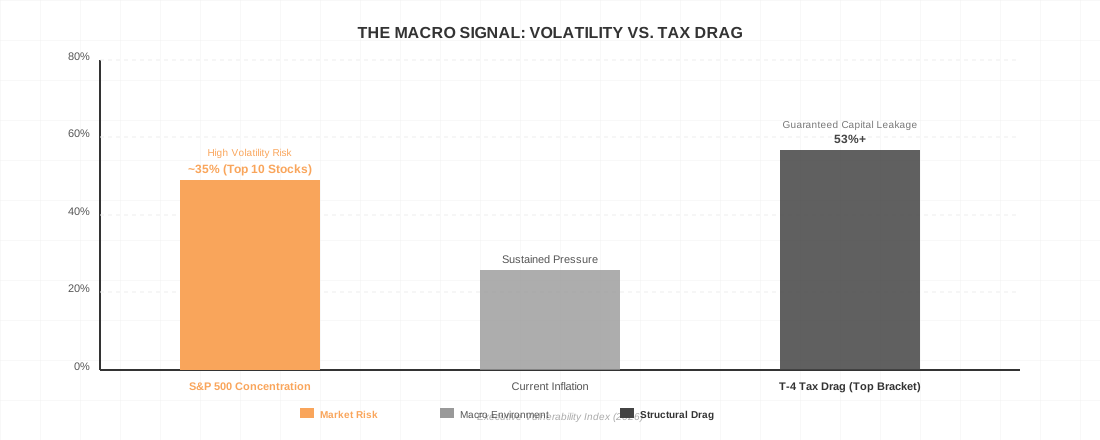
At the same time, the public equity markets are masking a severe underlying fragility: concentration risk. The top 10 stocks in the S&P 500 now account for roughly 35% of the index’s entire value. When a third of the market’s performance rests on a handful of companies, any localized correction in that sector triggers a systemic drawdown across your entire “diversified” portfolio.
For the average investor, this volatility is dangerous. For the high-T4 Canadian executive, it is mathematically catastrophic. Why? Because you are fighting a two-front war. You are facing the risk of market drawdown on one side, and a guaranteed structural tax drag of 53% or more on the other. Every dollar of passive income you generate is cut in half before you even factor in inflation.
This Market Update Canada highlights this dual challenge: the high volatility risk embedded in current market concentration versus the guaranteed, punishing drag of your marginal tax bracket. Understanding this Market Update is critical for executives who want to make informed decisions and build a resilient financial strategy.
—
PART 2: THE T-4 EXECUTIVE’S SPECIFIC VULNERABILITY
Let us be precise about why standard advice fails you.
The conventional “buy-and-hold” strategy was designed for average investors with average tax burdens operating in average market cycles. You are not average. Your tax burden is not average. And this market cycle is not average.
An executive earning $350,000 per year who deploys capital into a standard non-registered investment portfolio loses an enormous percentage of their compounding power to tax drag alone. This Market Update highlights why high-income Canadians need a more strategic approach focused on protecting capital and maximizing long-term growth.
The most significant “Money Leak” you have is not poor investment selection. It is the lack of a foundational structure. If your capital is deployed in a way that exposes it to full passive income taxation, no amount of market timing or stock selection will save you. You are trying to fill a bucket that has a massive, structural hole in the bottom.
A successful Market Update Canada strategy requires understanding how proper financial structures, tax efficiency, and long-term planning work together to support sustainable wealth creation.
Building a strong Wealth Building strategy requires more than selecting investments; it requires a structured approach that protects capital, improves tax efficiency, and creates sustainable long-term growth.
—
PART 3: THE 3 RULES OF MONEY — A DEFENSIVE FRAMEWORK
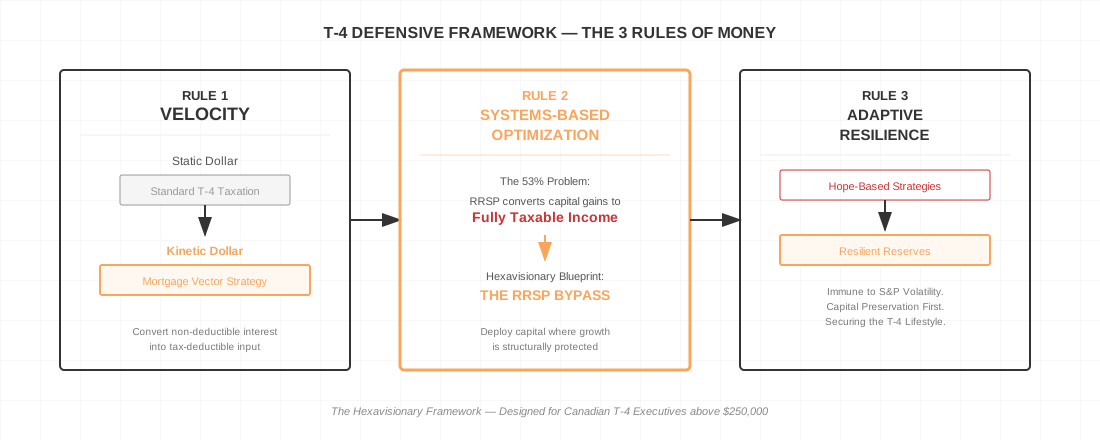
To survive and thrive in this economic climate, you must transition from passive accumulation to active Wealth Engineering. The Hexavisionary Framework operates on three principles we call the **3 Rules of Money**.
Rule 1: Velocity
A dollar sitting in a non-registered account, paying full tax, is a static dollar. Kinetic Wealth means keeping every dollar in motion — deploying it into structures where it generates tax-deductible inputs or grows efficiently. It means converting “dead equity” into working capital.
Rule 2: Systems-Based Optimization
The Top 9% do not out-earn their peers because they simply save more. They out-earn their peers because they utilize structures designed specifically for their marginal tax bracket. For the T-4 executive, the RRSP is often misunderstood. It is a tax-deferral mechanism that ultimately converts capital gains into fully taxable income upon withdrawal. A true engineered system seeks to bypass this trap, deploying capital where growth is structurally protected.
Rule 3: Adaptive Resilience
The market cycle you are entering rewards capital protection, not capital speculation. You need “Resilient Reserves” — capital deployed in ways that are immune to the volatility of the S&P 500, prioritizing preservation while securing your T-4 lifestyle.
The diagram below maps out exactly how these three rules shift your strategy from standard taxation to a customized, resilient blueprint.
—
PART 4: THE SPECIFIC TOOLS OF DEFENSIVE ENGINEERING
So, what does this look like in practice? For the T-4 executive, defensive strategy is about controlling what you can control: tax structure and debt efficiency.
One of the most powerful tools available is **The Mortgage Vector Strategy**.
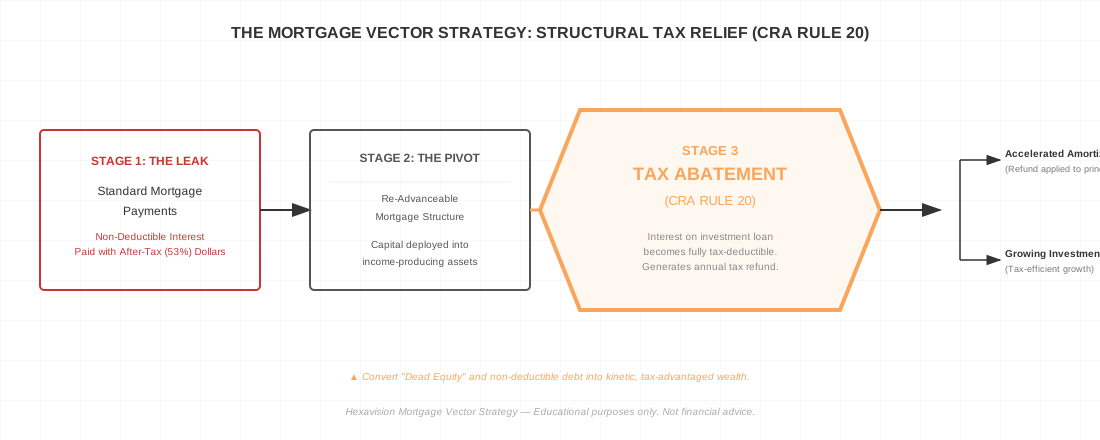
Most executives pay their mortgage using after-tax dollars. At a 53% marginal rate, you must earn more than two dollars to pay off one dollar of non-deductible mortgage principal. This is a massive structural leak.
Under CRA Rule 20, The Mortgage Vector Strategy allows you to systematically convert that non-deductible mortgage interest into a tax-deductible investment input. By utilizing a re-advanceable mortgage structure, as you pay down your principal, you deploy the available equity into income-producing assets.
The interest on that borrowed capital becomes fully tax-deductible. This generates an annual tax refund, which you can then apply directly back to your mortgage principal. The result? You accelerate your amortization timeline while simultaneously building a growing, tax-efficient investment portfolio — all without changing your monthly cash flow.
The schematic below outlines the exact mechanical flow of this strategy, from the initial “leak” of your T-4 income to the generation of structural tax relief.
—
PART 5: THE COST OF WAITING
The executives who will suffer most in the cycle ahead are not the ones who made bad investment decisions. They are the ones who made no structural decisions.
Every month that your capital sits in a structurally inefficient position is a month of compounded leakage. It is a slow, methodical erosion driven by tax drag and inflation.
The window to restructure is now. A portfolio restructured at calm seas adapts without friction. A portfolio restructured mid-storm pays the full cost of the correction while also absorbing the transaction cost of the pivot. You must build the architectural blueprint of your financial house before the market tests its foundation.

—
THE IMPERATIVE
You have won the Income Game. Now it is time to engineer the Wealth Game.
The strategies we have outlined — The Mortgage Vector, the RRSP Bypass, and the shift to Kinetic Wealth — are not generic products you can buy off the shelf at a retail bank. They are engineered blueprints designed specifically for high-earning T-4 executives who need a more strategic approach in today’s changing Market Update Canada environment.
This Market Update highlights why traditional approaches may not be enough for executives facing complex tax challenges, market uncertainty, and the need for a more efficient wealth-building structure.
If you are ready to stop guessing and start engineering, the next step is implementation. We have prepared an exclusive, on-demand masterclass that breaks down exactly how these structures are built and deployed for professionals in your exact tax bracket.
[Watch the Implementation Masterclass Now →](https://registration.hexavision.ca/signup-landing-page)
Borrowing to invest is a strategy that magnifies both gains and losses and is not suitable for everyone.
Stop Guessing. Start Engineering.
— Kanwaljit (Sunny) Kochar
Senior Wealth Strategist | Hexavision
—
Disclaimer: This content is for educational purposes only and does not constitute financial, tax, or legal advice. Strategies discussed (including leverage and insurance) involve specific risks and may not be suitable for everyone. Insurance products provided through Carte Risk Management Inc. Consult with a qualified professional before implementing any financial strategy.